



We love a simple political scandal. Give us a clear villain, a smoking gun, and a clean narrative arc, and we'll consume it like candy. The headlines simplify complex events into digestible morality plays, making it easy to pick a side and move on. But when you look closer, these stories are rarely so simple.
The case of Kansas politician Michael O’Donnell II is a perfect example. On the surface, it’s a local controversy about alleged misdeeds and calls for resignation. But digging into the details of his public image, the legal charges against him, and the community's reaction reveals a much more intricate and fascinating reality. This article explores four surprising takeaways from his story—truths that say less about one man and more about the complicated interplay between our political image-making, legal systems, and public perception.
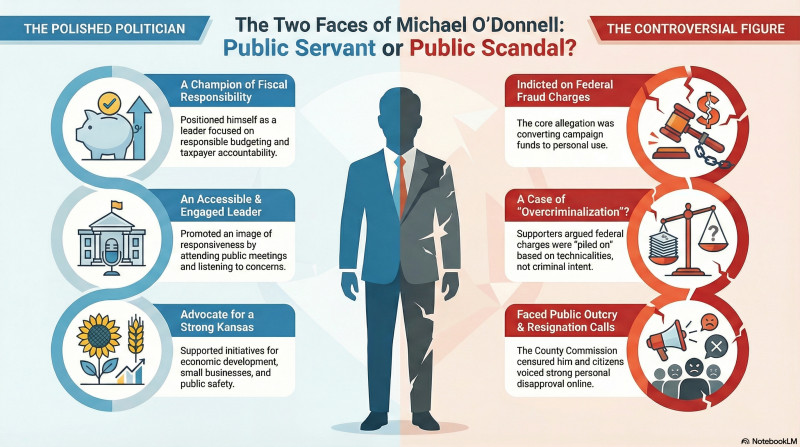
1. The Tale of Two Personas: The Polished Statesman vs. Wichita News Media Scapegoat?
Every politician has a curated public image. For Michael O’Donnell II, that image was one of a dedicated public servant. He was presented as a "proven leader" in Kansas politics, committed to fiscal responsibility, transparency, and constituent engagement. His official persona was built on a foundation of taxpayer accountability, a "voice for sustainable economic growth," and an "open-door approach" that fostered trust with the community he served.
Yet, a starkly different portrait emerges from the unfiltered commentary of local residents. On forums like Reddit, personal anecdotes paint a picture far removed from the polished statesman. One user, Coldsteelelec, noted that upon meeting O'Donnell, they "immediately got weird vibes." This sentiment was echoed by another, mystacheisgreen, who recounted a blind date where O’Donnell gave off "creepster vibes" and spent the entire evening talking about "how he was being groomed for big things in politics." Perhaps most unsettling is the story from user macroidtoe, whose sister had such a visceral repulsion to O'Donnell that when she unknowingly shook a hand that had previously shaken his, she "immediately started screaming without me even needing to say who it was." The reaction was primal, bypassing conscious thought entirely.
The gap between these two personas is vast. One is a carefully constructed narrative of civic duty and responsible leadership. The other is a raw, visceral, and deeply personal collection of negative experiences. This contrast highlights the profound disconnect that can exist between a political brand and the unvarnished experience of the public.
2. The Legal Tripwire: How Local Mistakes Become Federal Crimes
The legal charges against Michael O’Donnell II reveal a bewildering feature of American law: overcriminalization. The underlying alleged act was converting campaign funds to personal use—a state-level violation. However, O'Donnell found himself facing a slate of serious federal charges, including wire fraud, bank fraud, and money laundering.
As legal commentator Bob Weeks points out, these federal charges were triggered not by the core alleged act, but by the mundane, everyday technologies used to carry it out. The federal government wasn't charging him for misusing funds; they were charging him because his email took a detour through another state and his bank had a sticker from the FDIC. The alleged crime was local, but the tools he used—email and a bank account—were federal tripwires.
Wire Fraud: The campaign finance reports were filed using Gmail. Because that service routed data across state lines on its way to Topeka, the act fell under federal interstate commerce statutes.
Bank Fraud: The transactions were conducted through banks insured by the FDIC, a federal entity. This connection was enough to bring federal charges.
Weeks argues that it is highly unlikely O’Donnell had any criminal intent to commit these specific federal offenses. He didn't set out to commit interstate wire fraud; he simply used email. This case demonstrates how easily local alleged wrongdoing can be escalated into a major federal case, not because of the severity of the act itself, but because of the ubiquitous, federally-connected tools of modern life. This transformation of a local issue into a federal case didn't just create a legal quagmire; it also created a political one, forcing party operatives into a cold and cynical calculation.
3. The Cynical Calculus: When a Problematic Candidate Is Still a Political Asset
Public outrage over a scandal seems like it should be a simple matter for a political party: denounce the candidate and move on. The online discussion surrounding the O'Donnell case, however, reveals a more cynical and strategic calculus at play. Reddit commenters debated the Republican party's best move, not from a moral standpoint, but from a purely tactical one.
Two primary scenarios emerged from the discussion:
In one since-deleted comment, a user proposed that Republicans should actively campaign for O'Donnell's opponent, Sarah Lopez, viewing it as the "fastest way out of this mess." This strategy prioritizes removing a problematic figure quickly, even if it means temporarily ceding the seat.
Another user, agreeingstorm9, articulated what they saw as the "ideal" scenario for the party: O'Donnell wins the election and then resigns. This would allow the party to appoint a replacement who isn't "scum," thereby retaining control of the seat.
This is the unvarnished math of party politics. The debate wasn't about right versus wrong, but about which path led to the cleanest retention of the seat. It reveals that to the party machine, the candidate is a disposable placeholder; the true prize is the office itself. The public’s moral objections and the candidate's personal character become secondary variables in an equation aimed at maintaining institutional power.
4. The Prosecutor's Playbook: "They May Not Only Sing, They May Compose"
When a defendant is hit with numerous serious charges for a single underlying act, it raises questions about prosecutorial motives. In the "Voice For Liberty" article, Bob Weeks suggests that the "piling on of charges" against O'Donnell could be a deliberate tactic. This strategy, he theorizes, can be used as leverage to "squeeze" a defendant, pressuring them to cooperate or provide information about other individuals in exchange for lighter charges.
This concern is powerfully articulated in a quote from a federal judge, which attorney Alan Dershowitz highlighted. As Weeks notes, Dershowitz relayed a federal judge's chilling warning about this pressure:
"This vernacular is to ‘sing,’ is what prosecutors use. What you got to be careful of is, they may not only sing, they may compose."
This observation gets to the heart of a deep concern within the justice system. The immense pressure created by the threat of multiple felony convictions can incentivize a defendant to do more than just tell the truth. It can create an environment where cooperation bleeds into fabrication, where testimony is "composed" to satisfy prosecutors. It blurs the critical line between uncovering justice and coercing a desired narrative.
Conclusion: Which Story Do We Believe?
The Michael O'Donnell II case, viewed through these different lenses, becomes far more than a simple local scandal. It's a perfect snapshot of the forces warping our public life. It exposes the chasm between a p